Institut für Agrar- und UmweltanalytikQuerfurter Straße 9 06632 Freyburg/Unstrut, Germany
Haney + total digestion
€150
Soil Balancing + Haney + total digestion
In one order from the launch of the Mineral Balancing Tool. Until then: take two samples and use both order forms.
All prices are net plus VAT and include the laboratory analysis, interpretation and fertiliser recommendation by BodenBalance. Turnaround usually 3–4 weeks, occasionally longer. Questions after receiving your report? Advice by Lucas Kohl is included in the price.
Why BodenBalance
What sets Soil Balancing apart from classic Albrecht/Kinsey analyses
That nutrients promote or block each other is well documented – yet many analyses have failed in practice: excessive amounts, liming left out, calculated instead of measured values, no advice. BodenBalance takes the findings of Loew and Albrecht as a starting point, brings in current research and adds what practice has been missing.
CEC measured, not calculated
Potential CEC according to DIN ISO 13536 and effective CEC via Mehlich-3 and ammonium acetate – in an accredited laboratory in Germany. Simply summing up the cations leads to wrong base saturations and thus wrong fertiliser amounts.
Targets that fit the soil
The target base saturation is adjusted to the CEC instead of a flat figure, and bulk density is calculated from texture and humus instead of a single default – so the kg/ha are right. And it is not only about Ca : Mg : K: the ratios with and between trace elements are part of the recommendation too.
Potential acidity in view
Classic Albrecht interpretations overlook active aluminium and then wrongly recommend no lime. With the Haney test the ratio Ca + Mg : Al feeds directly into the liming recommendation.
Economically feasible
Annual caps, staggering over several years, priorities and timing instead of one giant application – the short- and long-term economics of the farm come first in every recommendation. All products are FiBL-listed, so usable in organic farming.
One sample, everything in
The statutory standard analysis (pH, P, K, Mg according to VDLUFA) is included – the sampler does not have to cross the field twice. Especially with external samplers this saves more than the analysis costs extra. The crop link comes with the upcoming Mineral Balancing Tool.
Advice and science included
How do I implement the measures, where do I start? The follow-up question after the report is included. The rules behind every figure are documented and continuously updated with new findings by a practising soil scientist.
Nutrients do not act alone but in relation to each other: an excess blocks the uptake of other nutrients, a balance increases availability, fertiliser efficiency and soil tilth – which means the soil life is fertilised too. Soil Balancing measures contents, cation exchange capacity and base saturation and derives a multi-year fertiliser plan that brings all nutrients into their ratio. The basis are the findings of Loew and Albrecht, developed further with CEC-dependent targets, measured bulk density and realistic annual amounts.
Parameters Standard
pH (CaCl₂), P, K (CAL), Mg – LUFA standard analysis includedCEC pot with Ca, Mg, K, Na on the exchanger (DIN ISO 13536)pH (H₂O), humus, total N, C/NCa, Mg, K, Na, S, P, B, Mn, Cu, Zn, Fe, Al by Mehlich-3CEC eff (calculated), texture
Parameters Premium
As Standard, plus molybdenum (Mo, hot-water soluble), cobalt (Co) and selenium (Se).
€169 Standard · €189 Premium net per sample
AGROLAB Sarstedt · Haney can be added: Standard + Haney €291.50 · Premium + Haney €311.50
Haney soil vitality
Conventional analyses ignore the soil life – here it is measured: soil respiration, microbial food C and N, and from these the soil vitality index. A nature-like extract (H3A – organic acids as roots release them) shows which nutrients the plant actually reaches, including trace elements and ratios. Plus the acidity gauge (Ca + Mg : Al), a cover crop recommendation based on C : N and a prioritisation of measures that takes antagonisms into account. In combination with Soil Balancing also N and P supply over the growing season.
Parameters
Soil respiration (CO₂ 24 h)water-extractable C and N (microbial food)NH₄-N, NO₃-N, PO₄-PH3A: Ca, Mg, K, Na, P, S, Al, Fe, Mn, Cu, Zn, B, Mo, CopH (H₂O), pH (CaCl₂)organic matter, C org, N total
Wet digestion under pressure (VDLUFA VII 2.1.1): the total reserve of every nutrient. The report relates it to the plant-available share from the Haney analysis – and that decides the measure: small reserve → fertilise. Large reserve but little available → do not fertilise, mobilise (correct nutrient ratios, feed the soil life, relieve compaction). High available share = active soil metabolism. Recommended for the first survey, then every 5–10 years.
Parameters
Ca, K, P, Mg, Na, SMn, Zn, Cu, B, Fe, Mo, Al, Co, Se
€30 net per sample · only in addition to Haney
IAU Freyburg
microBIOMETER® self-test
Microbial biomass and fungal-to-bacterial ratio in 20 minutes – in the field, with your smartphone. Not a lab replacement, but ideal for tracking measures between two analyses.
Starter kit €199 · refill kits from €95 net plus VAT
Balanced plant nutrition depends on the metabolism of the soil microbes. Conventional analyses (LUFA, Kinsey …) leave it out – here it is measured and brought together with the chemistry. Unlike the original Haney test, the desirable nutrient ratios are evaluated as well.
Microbial respiration (CO₂)
CO₂-C in mg/kg released by the microbes within 24 h after rewetting – the direct measure of activity. 0–30 low: slow decomposition, N has to be fertilised. 30–100 average: above 70 N can be reduced. > 100 high: supply more carbon, year-round cover. Sandy, dry sites reach less than silty, humid ones.
Microbial food C and N
Water-extractable carbon and organic nitrogen – the microbes’ food from root exudates and turnover. High values and a good C : N ratio are the goal.
Microbially active carbon
Share of the microbial food C that was respired. Above 80 %: the food is not enough, the microbes turn to the humus. Below 30 %: it is not the food that limits activity but something else (compaction, acidity, drought).
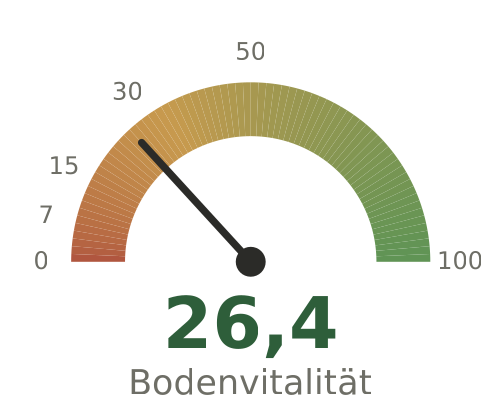
Soil vitality
One figure from the level and ratio of respiration, microbial food C and N. Below it, in small print, the Soil Health Score (SHS) by US calculation for comparison with original Haney interpretations.
Plant-available CEC & base saturation
Sum of Ca, Mg, K, Na and H⁺ from the H3A extract – the immediately available part of the exchanger, much smaller than the potential CEC from Soil Balancing. Plus the cation ratios with targets: better ratios improve air and water regime and thus the habitat of the microbes.
Nutrients from the H3A extract
Nitrate-N, ammonium-N, P, S, B, Fe, Mn, Cu, Zn, Mo, Co: what is available to the plant right now. Balance deficits by fertilising or mobilising; in case of excess, pause fertilising.
Ratios
Only the pairs that, in the red zone, slow down microbes, growth and resilience. Marker in the middle = balanced; if it moves, the named nutrient is in excess.
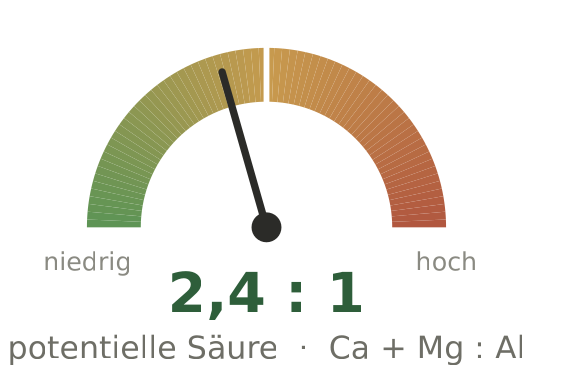
Potential acidity
Ca + Mg : Al from the H3A extract. Aluminium is acidifying; the less Ca and Mg oppose it, the higher the potential acidity. Target 2 : 1 (white mark). High values worsen conditions for roots and microbes – remedy via Ca and Mg supply.
Cover crop recommendation & prioritisation
Ratio of grasses to legumes/brassicas from C : N and vitality: narrow C : N → more grasses, wide → more legumes. Measures are prioritised in four levels and take antagonisms into account – a Mo deficiency only counts if S is sufficient, for example.
With total digestion: reserve or availability?
Total reserve
available share (H3A in % of total)
Measure
sufficient
high (e.g. Ca > 8 %, K > 3 %, S > 15 %)
active soil metabolism – fertilising usually not needed, small doses in the range of crop removal if any
sufficient
low
nutrient is bound or blocked → mobilise: correct ratios, biostimulants, cover crops/undersowing, relieve compaction, build humus
low
low
real deficiency → fertilise, and improve availability
Exceptions with a target range instead of “the higher the better”: microbial food C 2–4 %, microbial food N 3–5 %, nitrate-N < 0.3 %, ammonium-N < 0.5 %, Fe and Mn 1–3 %, Al < 0.5 %.